This page is reflective wellbeing writing, not therapy, diagnosis, treatment, crisis support, or medical advice. Use it as a gentle page to read, and use qualified support for persistent, severe, unsafe, or health-related concerns.
Creative self-care can be as small as making a few marks on scrap paper or arranging three familiar objects. Choose something you can leave unfinished, using materials already within reach. The decision guide below offers a starting point for the time and space you have; its suggestions are optional, and stopping is always available.
Start with the conditions you actually have
Perhaps you have closed the laptop but still feel pulled towards another task. A creative activity can offer something to do with your hands or attention without needing a finished piece. For this guide, creative self-care means choosing a small act of making, noticing, or playing for your own use. You do not need to call yourself an artist, buy supplies, or share the result.
That working definition is an editorial invitation, not a treatment method. The National Institute of Mental Health includes enjoyable activities and low-stress hobbies among its self-care suggestions. It also says that what people need and enjoy differs. It does not prescribe the prompts below or promise that a particular creative exercise will change how you feel.
Before choosing an activity, look at your surroundings. Is there a surface you can use? Would noise disturb someone? Is cleanup a burden tonight? If you need food, sleep, practical help, or a conversation more urgently, it is reasonable to attend to that need first. Creativity does not have to earn a place in every evening.
Choose a route by time and materials
The decision guide uses two practical inputs: whether you want a short or longer activity, and whether paper, a phone, or no materials are available. Time means a suggested stopping point, including putting things away. It is not a minimum dose. A five-minute choice can end after one minute; a fifteen-minute choice can stay unfinished.
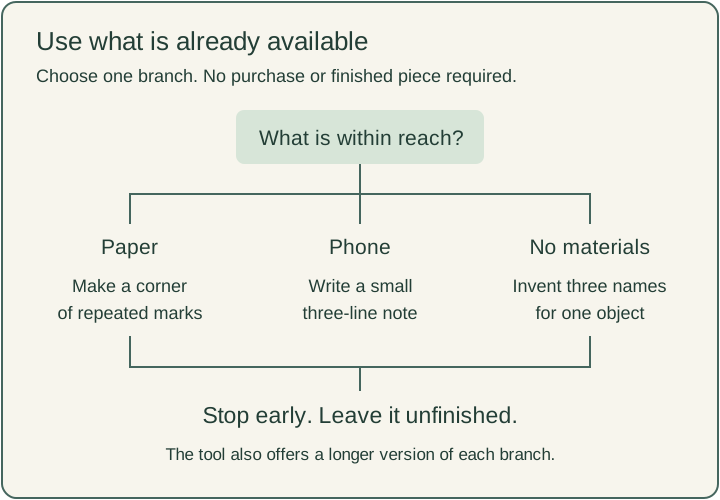
If there are several routes you could use, choose the one with the least preparation. For example, a pencil already beside you may be easier than finding paints. If using a screen feels like another demand, choose the no-material route even when a phone is available. The tool makes no assessment of your mood, health, skill, or needs.
Paper: make a page that needs no audience
For a short paper activity, draw a loose outline around the page and fill one small corner with repeated marks: dots, curves, uneven squares, or the shape of a nearby leaf. Use any ordinary writing tool. Let the lines differ. You can stop when that corner feels full or whenever you want to put the pencil down.
For a longer paper activity, fold a sheet into four sections. In each section, draw something you noticed today: a cup handle, a window shape, a shoe by the door, a patch of light. The object can be represented by a few lines. Leave a section empty if nothing comes to mind. This gives you somewhere to begin without asking you to produce an account of your whole day.
Another option is a small word collage. Write six ordinary words from your surroundings, such as curtain, spoon, pavement, blue, key, and quiet. Move them into an unexpected sentence. You can use invented words or leave the sentence incomplete. Avoid turning this into a prompt to disclose painful experiences; a page about a spoon is sufficient.
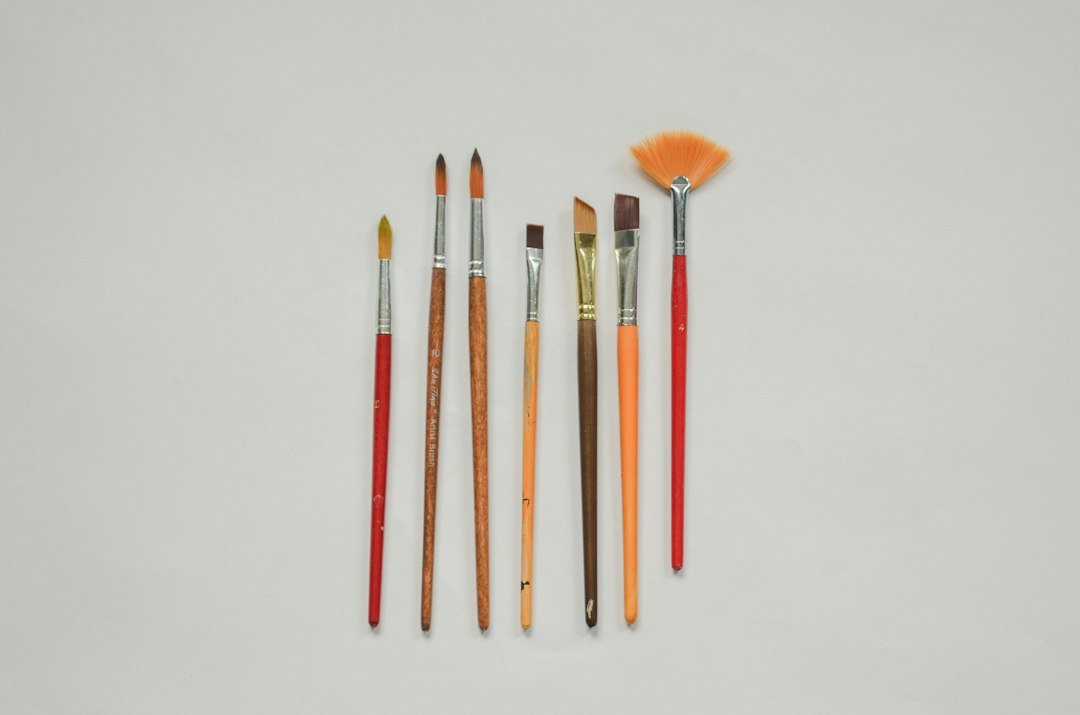
Keep materials simple. Paints add setup and cleanup, so save them for a time when that is welcome. Follow the product instructions for any materials you use. Tonight's activity can use a pencil and the back of an envelope. The photograph of brushes is one possible creative medium, not a shopping list.
Phone: make one small thing, then leave it there
For a short phone activity, use your notes app to write a three-line description of something nearby. Try one line about shape, one about colour, and one about a detail you had not named before. No photograph or internet connection is necessary. Close the note when you reach the third line, even if the wording feels ordinary.
For a longer phone activity, make a tiny collection around a theme: three colours in your room, three shapes on your desk, or three sounds you can describe in words. You might take photographs of your own objects, sketch with a basic drawing app, or write captions. Keep the collection small enough that choosing and editing do not take over the activity.
Consider privacy before saving or sharing anything. Leave other people, addresses, workplace screens, and private messages out of photographs. A creative record can stay private. You do not need to upload it, compare it with someone else's work, or turn it into a daily posting habit.
The guide runs on this page without a server submission. Its choices are not saved after a reload. Your browser and device may still have their own history or screenshot features; use a setting you are comfortable with. You can also ignore the tool and follow one of the written prompts.
No materials: notice, arrange, or invent
For a short activity without materials, choose an object you can see and give it three imaginary names. A lamp might become a moon stand, a reading companion, or a small indoor sunrise. Keep the names silly or literal. You can do this silently and leave no record.
For a longer activity, imagine a tiny exhibition of three familiar objects. Choose them mentally, decide what connects them, and invent a title. If it is easy and safe to move your own objects, you could arrange them on a clear surface. Leave shared, fragile, valuable, or necessary items where they belong. An imagined exhibition works just as well for this invitation.
If focusing on objects is unappealing, invent a two-sentence story about a fictional place. Begin with something concrete: a bakery that opens at midnight, a bus stop beside a garden, or a library with one unusual shelf. Nothing needs to happen next. You can stop at the setting instead of solving a plot.
These routes are designed to avoid a supply requirement, but they will not suit everyone. Adapt them to how you see, hear, move, read, and communicate. Describing a shape aloud, imagining a colour, or asking someone to name an object are possible alternatives. Choose what is comfortable; there is no required version.
Give the activity an ending it can keep
An ending can be practical: put the pencil back, close the note, or return the objects to their places. You do not have to decide whether the activity was successful. If a short observation would help, try: “I would repeat this,” “I would change the materials,” or “This was not for tonight.” None of those answers obliges you to continue tomorrow.
Suppose you chose the longer paper route and spent most of the time finding a sheet. You can make one mark and stop. Next time, you might use the short route or leave a pencil somewhere convenient. The useful adjustment concerns the setup; it does not require a judgement about your creativity or discipline.
If creative time starts feeling like another obligation, reduce it or leave it out. Our guide to self-care when you do not want another routine explores that pressure. Keep any rhythm optional, including the decision to return to the same prompt several times.
When a prompt is not the support you need
An activity can be uninteresting, frustrating, or bring up something you did not want to explore. Stop or change direction if that happens. You do not need to work through distress by making more art. This article offers ordinary leisure ideas, not art therapy, diagnosis, or a substitute for professional care.
NIMH advises talking with a primary care provider about mental-health concerns and seeking professional help for severe or distressing symptoms lasting two weeks or more. That guidance is not a reason to wait if you need support sooner. If you are in immediate danger, contact local emergency services. A creative prompt can wait while you get help.
For an ordinary evening, the next step can remain small: choose one available route, try an action, and leave yourself free to stop. The unfinished page can stay unfinished.